

Hello friends, Liz here.
Queen Annie did warn me: “Almost every single thing you hope publication will do for you is a fantasy, a hologram…”
Exactly one year ago today, my first book, Knock at the Sky: Seeking God in Genesis After Losing Faith in the Bible, released from Eerdmans Publishing, making me a bonafide author.
As I reflect back on my year, I’ve decided to revisit a series I began in the month before my book arrived. I called the series, ”A debut writer’s publishing story,” and it was a glimpse behind the curtain.
Psst, the series starts here:

Now, that I’ve graduated to one year post-publication, I have thoughts. And I want to answer the question, “Now, what?”
After laboring for twelve years in the journalism mines (;-)), publishing at nowhere zines for zero dollars1 and then finally publishing in places you may have heard of, amassing several book publishing rejections, getting one agent and then swapping for a second agent, and then selling a book and finally seeing my words in print… what comes next? What does publishing mean to me now? What have I learned one year later?
The answer to all of the above is this: Annie was right. (She’s always right.)
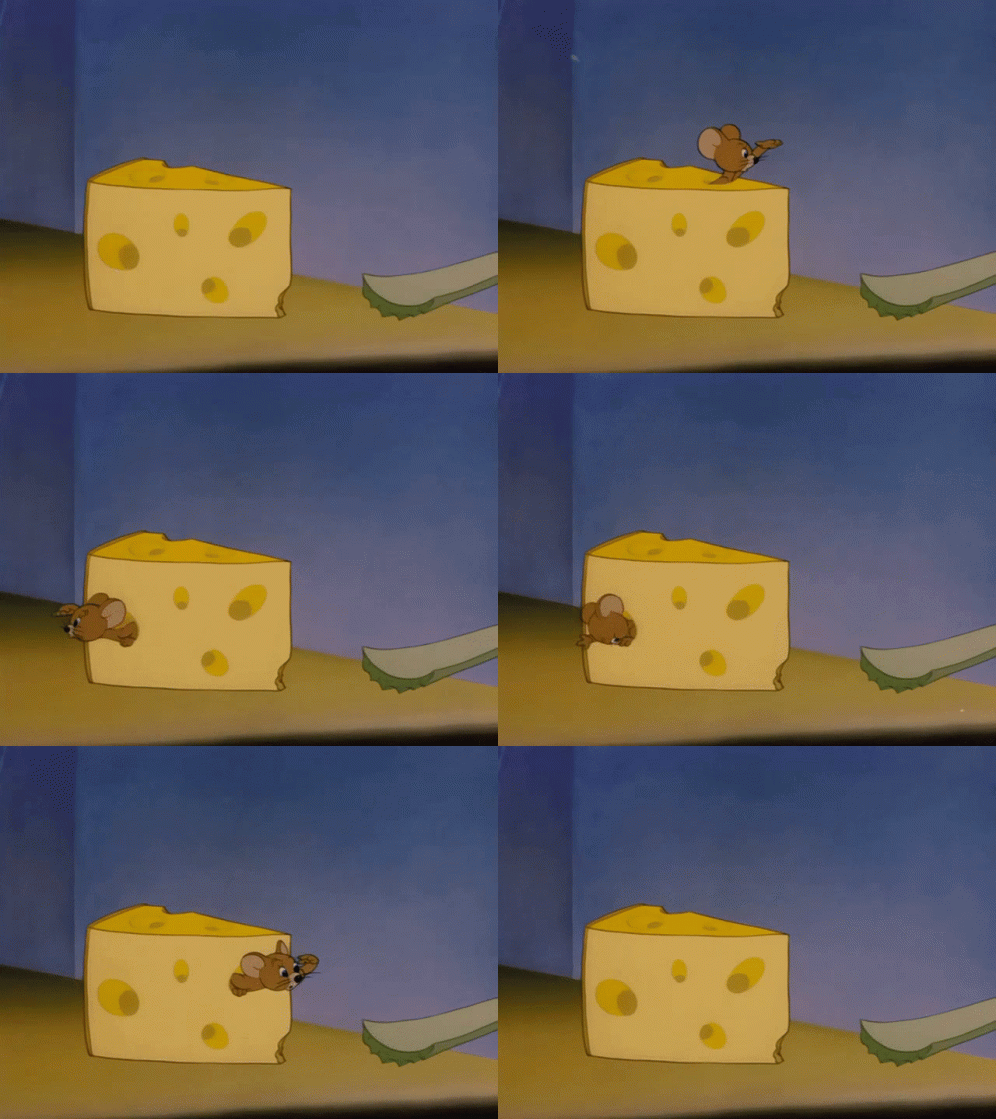
Publishing does not fill all the swiss cheesy holes in a writer’s heart. But writing does.
What Annie Said
In Bird by Bird, Anne Lamott confesses that she visualized the publication of her first book (at 26, by the way! By Viking!) in the register of a Hallmark commercial—so much leaping across meadows and bounding into pillows of wildflowers to be held within the muscled arms of success and self-esteem.
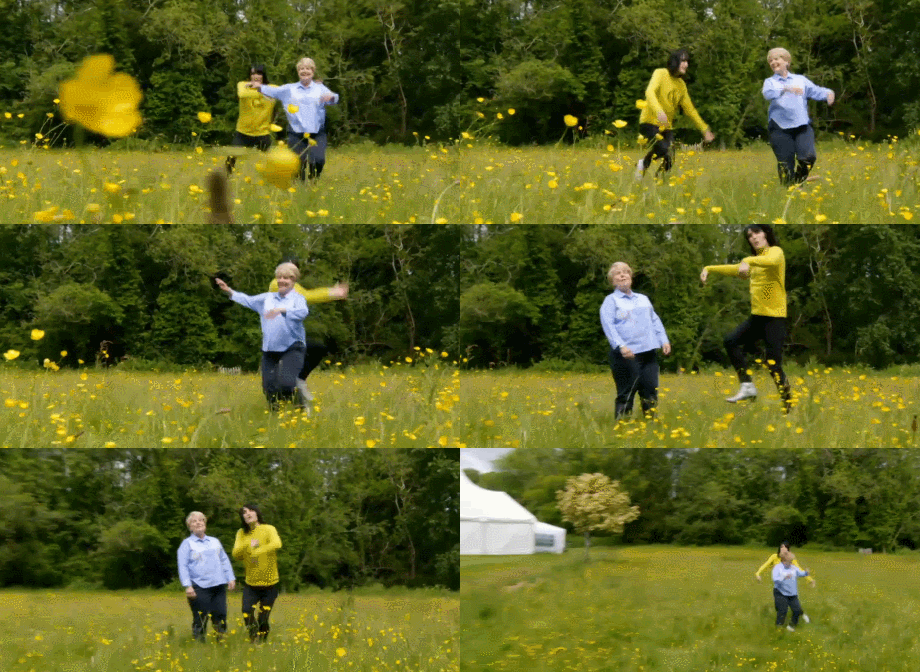
Trumpets would trumpet. Reviewers would weep for joy at the discovery of the next great literary talent. In fact, like every writer in her heart of hearts, Anne expected early retirement to arrive shortly thereafter.
“This did not happen for me,” she says.
In fact, she tells us, these visions of grandeurs did not materialize after the publication of book number 2, 3, 4, or 5. You could argue that right now, at the end of her career, Annie has made it. But for a writer, “making it” means that our typing addiction finally pays the bills. And paying the bills is a feat so rare for writers that it’s hardly worth considering the success stories. So says Annie, anyway.
Publishing, she says, “…will not make [my writing students] well. It will not give them the feeling that the world has finally validated their parking tickets, that they have in fact finally arrived. My writer friends, and they are legion, do not go around beaming with quiet feelings of contentment. Most of them go around with haunted, abused, surprised looks on their faces, like lab dogs on whom very personal deodorant sprays have been tested.”
But oh, how we writers want publishing to mean everything. Sigh.
I can relate to this idealized vision of publication, although I had plenty more opportunities than Annie to become disillusioned by the entire publishing landscape.
I did not publish a book in my twenties. I amassed 300+ writing rejections, in fact. I never made a 30 under 30 list (or even a 5 under 35 list), and at age 38, I suspect that my chances of making any sort of 40 under 40 list to be equally unlikely (LOL). I have still not published under a “Big 5” publishing imprint, and writing had never covered my monthly mortgage payment.
Having experienced the backside of the publishing industry, I understood better than most first-time authors how my publisher viewed me. Though I did find a press to publish my weird arty theology book, I knew that they did not expect my book to be a blockbuster. (Even if I had managed to nab some excellent endorsements—Barbara Brown Taylor! Odds and Enns! And Sarah Bessey as a foreword writer, are you kidding me?) My very modest advance reflected this hesitancy.
However, my publisher still did its best to support me, and I’m fairly certain I worked my publicist, editor, and the design team to the bone with my detailed and endless email requests. (Thank you, friends, your sacrifice will never be forgotten.)
I also worked hard. I edited the manuscript like a mother f—er. I copyedited too many times, I reviewed art and print color swatches, and I sent so, so many emails to the team. I also bought a new microphone and a screen to place behind my computer so I could pitch myself as a podcast guest. (In all, I lined up nearly 50 interviews, 44 of which have released!) I made merch (cards, stickers, and riso prints, oh my!), canva graphics, and even hired a friend to illustrate quotes from my book for instagram. I created a behind-the-scenes podcast to document the artistic experience of making the book alongside my artist husband, and I paid a friend to produce it for us. I attended conferences both to network and to hand out free chapbooks with a sample chapter for readers to take home as a prequel to the IRL book.
All that before the release.
After the release date, the publicity campaign ramped up. Podcast episodes released. Instagram Lives were had. Substack collaborations commenced. Colorado friends threw me a launch party at a beloved coffee shop. Some reviewers raved, while others offered real criticisms (both were welcomed, by the way). Publisher’s Weekly and Foreword Reviews both deemed my book interesting enough to review, which I’m guessing was a surprise both to me and my publisher. And people started to place copies on their bedside tables.
So then, how did my book do?
Did my book soar to the top of the charts? Did I hit bestseller status? Did I see photos of celebrities casually reading my book while on the subway?
Not so much.
My book did sell… just not meteorically, and not well.
No, I’m not going to give you a number. (The number ultimately matters less than the attention a reader offers. Even one minute is a gift.)
Truthfully, when I think of the precise number of books sold, sometimes I feel embarrassed. The number feels so small compared to the wide world. But I also feel awed that people—even one person at all!—would take my words onto their bookshelves.
What I will say is, in the first six months of my book’s publication, I did NOT earn out my advance—as in, I did not pay back the amount my publisher had paid me to write the book. And TBD if I have paid back my advance by the end of this year (today I sent yet another email to ask for the final numbers of book sold in the various formats).
Whenever I do pay back the advance, only then would I begin to see minuscule royalties on future book sales to the tune of less than 20%. So, the prospect of making money from this very good book I wrote does not look great. (Partly because I have spent more on marketing than I have made on book sales!!) Publishing has lost me money.
Because of these equations, some in the industry would consider my book a failure. I know this because, when I went to pitch a second book, editors did not line up to wave their checkbooks at me. (Rude.)
Then again, I did sell another book. I found a publisher for book 2, which was the one goal I had set for myself at the beginning of my publishing journey. I aimed to keep writing books. And book number 1 allowed me to do that… even if my advance for book number 2 still will not pay my mortgage. (Real talk 😉)

But who needs a paycheck, anyway?
In fact, books don’t provide many authors with paychecks, just the tippy top percentage of bestsellers. However, books do provide their authors with other incentives.
Adding a published book to my CV has brought other sorts of opportunities, including the chance to write an online monthly column for the Christian Century magazine.
Here’s where I admit that I’d never heard of the magazine before I dipped a toe into the mainline denominations. Now I understand that it’s a historic kind of Harper’s Magazine for progressive protestants. (My editor calls it “the New Yorker for religion nerds.”) W. E. B. DuBois published in its pages. So did C. S. Lewis, W. H. Auden, T. S. Eliot, Marilynne Robinson, Wendell Berry. So did a pope or two. Martin Luther King, Jr. was an Editor-at-Large for a time, and that’s where he first published “Letter from a Birmingham Jail” in 1963. Friends, I do not mean to place myself on a level with these luminaries, but I want you to understand what it means to me to write a column for such a storied publication: it means a lot.
And my book did that for me.
I’ve also had the chance to speak with people IRL about my book and the issues it raises. I arranged a DIY book tour after my book’s release and visited 8 states this year (two places I visited on behalf of the Christian Century). While there, I talked in front of large and tiny crowds, presented off-the-cuff and with powerpoint, headlined/sidelined at conferences and churches alike. I talked on zoom some, as well, but the in-person gatherings meant the most.
And I’ve met so many other creatives, authors, theologians, podcasters, and thinkers throughout this year!! I have so many new friends.
And my book did that for me, too.
But wait, there’s more!
The other thing my book did for me? It exists.
Here’s what I mean, and here’s where Anne Lamott proves herself a genius once again: the fact that someone invested money to print my words on a page and that others have bought that book to read, well, that accomplishment never goes away.
Here’s how Annie puts it:
“…The fact of publication is the acknowledgment from the community that you did your writing right. You acquire a rank that you never lose. Now you’re a published writer, and you are in that rare position of getting to make a living, such as it is, doing what you love best. That knowledge does bring you a quiet joy.
…There can be a great deal of satisfaction in being a writer, in being a person who gets some work done most days, and who has been published and acknowledged. I carry this around in my pocket, touch it a number of times a day to make sure it is still there. Even though so much of my writing time is stressful and disheartening, I carry a secret sense of accomplishment around with me, like a radium pack implanted near my heart that now leaches a quiet sense of relief through my system.
She goes on to acknowledge that “you pay through the nose” for this small sense of relief, the relief of having been published once. The ego, the self-doubt, the financial woes, “ruin, hysteria, bad skin, unsightly tics…”: these go with publishing a book. And eventually, you do have to sit before a blank page again and pray that another idea descends to your finger tips.
But still: my book exists. And I’m so damn proud.

So, what does publishing mean to me now, one year from the release date?
Everything and nothing. It’s both gift and burden. And, no surprise, I love writing the most. (Publishing does not compare.)
One last word of advice from Queen Annie: “Try to bust yourself gently of the fantasy that publication will heal you, will fill the Swiss cheesey holes. It won’t, it can’t. But writing can. So can singing.”
This is life advice, not writing advice. Success, accolades, positive press, an adoring public, any sort of public at all: these do not make us whole. They actually escort us further away from wholeness, so that now we have to traverse the treachery of parasocial success in addition to our interior sense of failure. That makes two mountains to scale.
I have learned over and over that being good enough is interior work. No outside accomplishment—not even publishing that first book, the accomplishment of which I had dreamed since I was a child, fingering the names on the spines of the books stacked on the family room bookshelf—not even this fills the needy Swiss Cheese heart.
The best medicine to meet those needs? It’s the very ordinary daily stuff: people, Jesus, rest, food, art, gathering, sunshine.
…but publishing is terrible medicine. ;-)
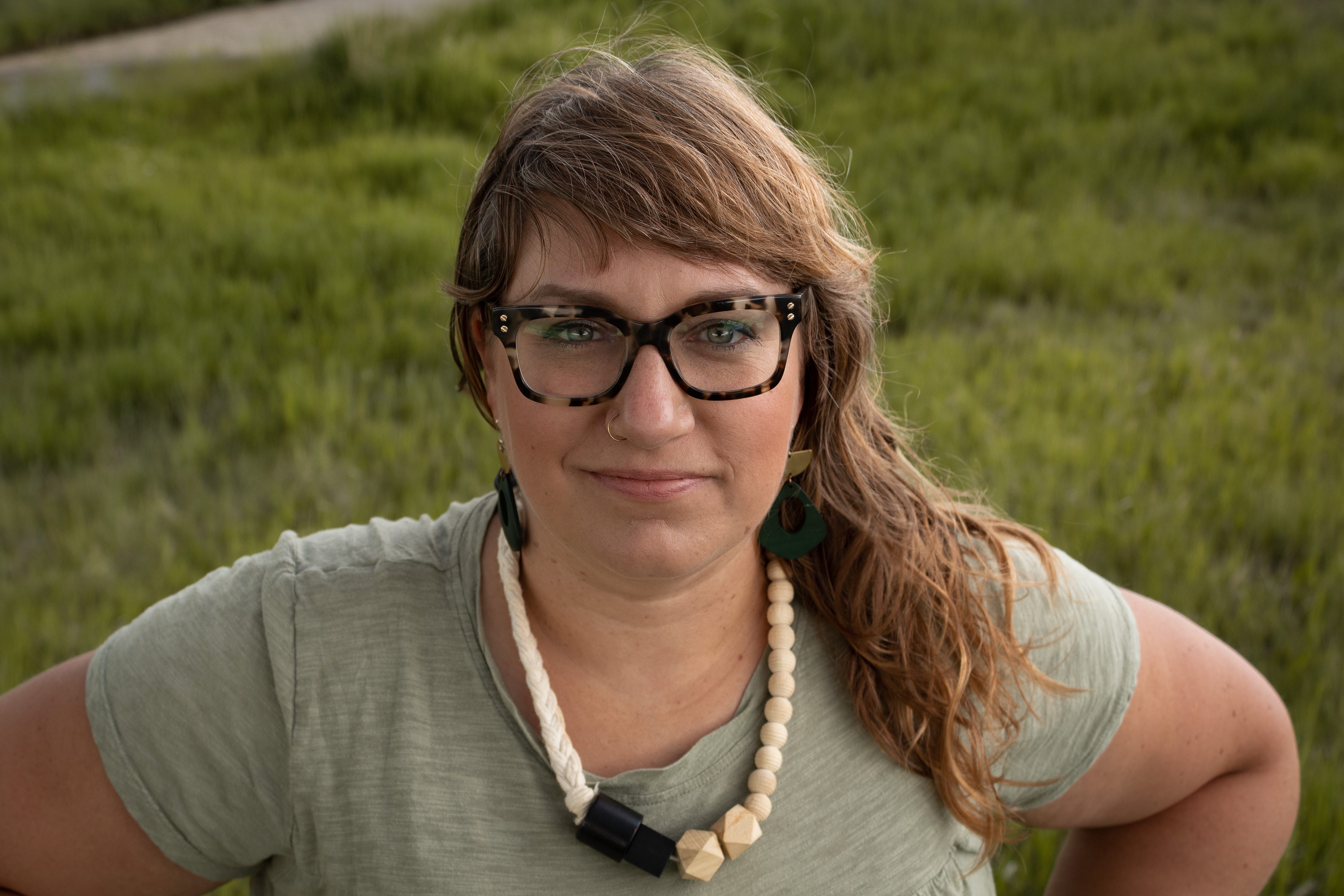
Thanks for reading.
Warmly, Liz Charlotte Grant
P.S. Friend, if you’d like to buy my book for yourself or a friend, or if you’d like to leave me a review on Goodreads, I’d be grateful for the support!
Just for Fun…
A selection of the 30 most disappointing people under 30.—the New Yorker
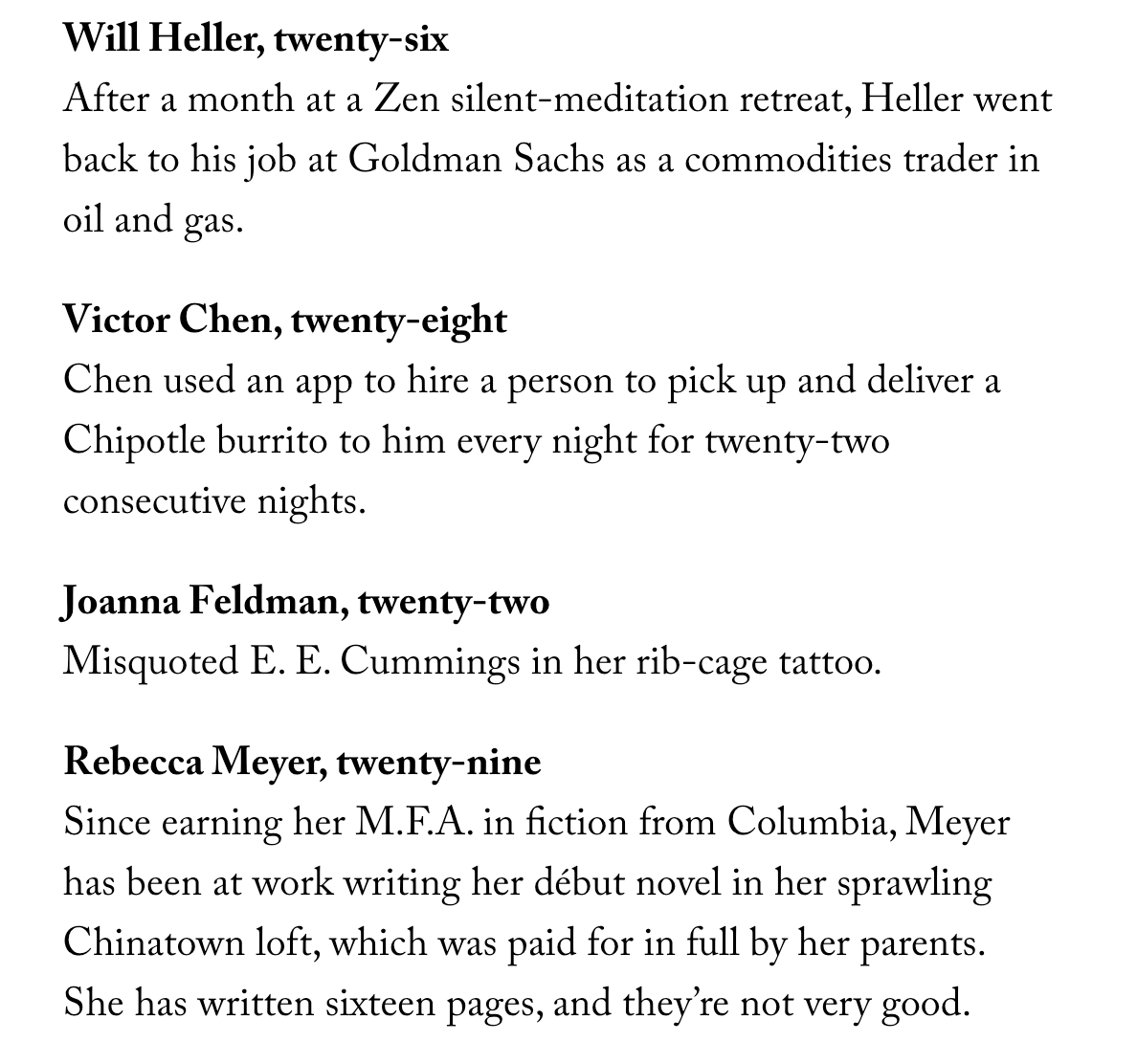
I adore literary magazines, I do. But they did not help me to publish my first book, and they did not lead to a financially stable career. In fact, I bled money in seeking the affirmation of the aforementioned magazines and their editors. Sigh. Perhaps that’s a story for another time? (Lit mags, don’t stop! We really need you! I’m sorry for spilling the tea!)
Thanks for including me in the journey and being so honest. We need this in the publishing world.
I appreciate your honesty & encouragement, Liz!